


Apr 18, 2016
- Read through the explanations.
- A | What do you do?
To find out what someone’s job is you say ‘What do you do?’
Here, Kerstin talks about her job:
‘I work for a large European car maker. I work on car design. In fact, I run the design department and I manage a team of designers: 20 people work under me. It’s very interesting. One of my main responsibilities is to make sure that new model designs are finished on time. I’m also in charge of design budgets.
I deal with a lot of different people in the company. I’m responsible for co-ordination between design and production: I work with managers at our manufacturing plants.’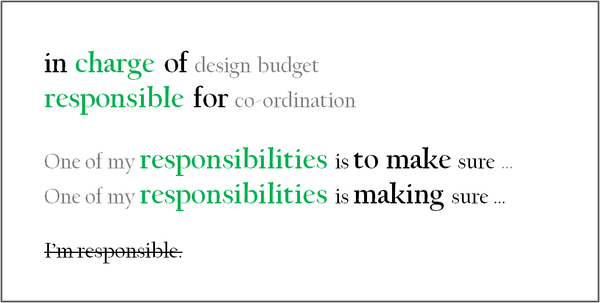
B | Word combinations with ‘work’
If you work or have work, you have a job. But you don’t say that someone hasa work.
Work is also the place where you do your job.
Here are some phrases with ‘work’: - ‘Hi. I’m Frank. I work in a bank in New York City. I leave for work at 7.30 every morning.’
‘I go to work by train and subway.’
‘I get to / arrive at work at about nine.’
‘I’m usually at work till six.’
‘Luckily, I don’t get ill very much so I’m not often off work.’
› The economy is growing fast and more people are in work than ever before. The percentage of people out of work has fallen to its lowest level for 30 years.
Note:I’m at the work.I’m going to the work.
C | Types of job and types of work
A full-time job is for the whole of the normal working week; a part-time job is for less time than that.
You say that someone works full-time or part-time.
A permanent job does not finish after a fixed period; a temporary job finishes after a fixed period.
You talk about temporary work and permanent work.
- A | What do you do?
- Pierre is talking about his work. Correct what he says.
- I work for a French supermarket company.
- I work . . . the development of new supermarkets.
- about
- on
- In fact, I . . . the development department and I . . . for a team looking at the possibilities in different countries.
- run, manage
- running, am manage
- It’s very interesting. One of my . . . is to make sure that new supermarkets open on time.
- main responsibilities
- main
- I’m also . . . financial reporting.
- in charge of
- charged with
- I deal . . . a lot of different organizations in my work.
- with
- at
- I’m responsible . . . planning projects from start to finish.
- of
- for
- I work closely . . . our foreign partners, and so I travel a lot.
- near
- with
- I work for a French supermarket company.
- Complete the text with one of the prepositions below.
to at off in out of - Rebecca lives in London and works in public relations. She leaves home for work at 7.30 am. She drives work. The traffic is often bad and she worries about getting work late, but she usually arrives work at around nine. She finishes work quite late, at about eight. ‘Luckily, I’m never ill,’ she says. ‘I could never take the time work.’ She loves what she does and is glad to be work. Some of her friends are not so lucky: they are work.
- Rebecca lives in London and works in public relations. She leaves home for work at 7.30 am. She drives work. The traffic is often bad and she worries about getting work late, but she usually arrives work at around nine. She finishes work quite late, at about eight. ‘Luckily, I’m never ill,’ she says. ‘I could never take the time work.’ She loves what she does and is glad to be work. Some of her friends are not so lucky: they are work.
- Write about each person using words from C opposites.
- 1. ‘I’m Alicia. I work in a public library in the afternoons from two until six. I have a . . . job.’
- full-time
- part-time
- 2. My husband works in an office from 9 am to 5.30 pm. He has a . . . job.
- part-time
- full-time
- 3. Our daughter works in a bank from eight till five every day. She works . . . .
- full-time job
- full-time
- 4. ‘I’m David and I work in a cafe from 8 pm until midnight. I work . . . .’
- full-time
- part-time
- 5. My wife works in local government and she can have this job for as long as she wants it. She has a . . . job.
- permanent
- temporary
- 6. Our son is working on a farm for four weeks. He has . . . job.
- temporary
- a temporary
- 7. Our daughter is working in an office for three weeks. She has . . . work.
- a temporary
- temporary
- 1. ‘I’m Alicia. I work in a public library in the afternoons from two until six. I have a . . . job.’
arrow_backarrow_forward
© 2020 DrillPal.com