Jun 9, 2016

Fluent English — Lesson 1 — INS Office

125 cards
, 157 answers
  • Making Small Talk


    Sergei, a Russian immigrant, is waiting in line at the INS. The line is very long, and it’s moving very slowly. Peter, an American, standing in front of Sergei, turns around and strikes up a conversation. Sergei is surprised by his friendliness.


    Peter      I guess we didn’t have anything else to do today, did we?
    Sergei      What?
    Peter      I said I guess they think that we didn’t have anything else to do today. It’s just that we’ve been in this line for a very long time. It seems like we aren’t going anywhere very fast.
    Sergei      Yeah. I know. I’ve been here since about 9:30. What about you?
    Peter      I think I got here just a few minutes before you did. I decided to pick up a green-card application for my wife. I should’ve gotten it off the Internet. That way I could gave just stayed home. Say, where are you from?
    Sergei      Me? I’m from Russia.
    Peter      Oh, whereabouts?
    Sergei      I lived in Moscow for most of my life, but I moved around a little. I was in the military.
    Peter      Interesting. I’ve never been to Russia, but I’ve always wanted to visit. It seems like such an interesting country. How long have you lived here?
    Sergei      I’ve lived in San Diego for only a few weeks, but I’ve been in the U.S. since August.
    Peter      Well, welcome to San Diego. I guess the weather must be a bit warmer than where you’re from, huh?
    Sergei      Yes, that’s true. I’ve gotten used to it.
    Peter      Have you visited the zoo or Balboa Park yet?
    Sergei      No, but I really want to go to Balboa Park. I’ve heard about all the flowers and museums that are there.
    Clerk      Next!
    Peter      Hey, That’s me. Gotta go. See you around.
    Sergei      Oh. Ok. See you.
    • I.N.S. Vocabulary

      Perhaps you need to go to the I.N.S. to fill out some forms. Here are some terms you would see if you were to fill out an application to register for permanent residence. Many of these words have other meanings, but these are the usages you will see on I.N.S. forms and other legal documents.
      •  . . . 
        To be cited.
        — To be summoned to appear in court. — Example
        The police could cite you for littering if you throw trash out of your car.

        •  . . . 
          To be indicted.
          — To be charged with a crime. — Example
          Richard Hayward was indicted for espionage when he was caught selling U.S. documents to a foreign government.

          •  . . . 
            Ordinance.
            — A law or regulation, usually passed by a local government. — Example
            The city council passed an ordinance permitting the use of marijuana by cancer patients.

            •  . . . 
              Beneficiary.
              — A person who is or will be the recipient of something of value from someone who has died. — Example
              Harold and Gerry were the sole beneficiaries of their mother’s modest estate.

              •  . . . 
                Rehabilitation.
                — Treatment to help someone return to regular, acceptable, or normal behavior
                or abilities. Recovery from drug abuse or physical injuries. — Example
                It was difficult to convince the governor that Sam has been successfully rehabilitated and was ready to leave jail and return to society.

                •  . . . 
                  Clemency.
                  — A lesser penalty than what a court originally suggested. — Example
                  Thinking that Ralph Smith had suffered enough for the crime he committed, the judge granted him clemency and gave him a shorter prison sentence.

                  •  . . . 
                    Amnesty.
                    — A pardon given to a large group of individuals. — Example
                    The government granted amnesty to all illegal immigrants who had come to work in the fields.

                    •  . . . 
                      To engage in.
                      — To become involved in something, to do something. — Example
                      Teresa would never engage in illegal activities, even if she disagreed with a law.

                      •  . . . 
                        To induce.
                        — To influence someone to do something. — Example
                        Robbie’s older brother induced him to steal money from their parents.

                        •  . . . 
                          To conspire.
                          — To plan together in secret to do harm. — Example
                          Kathy and Jane conspired to make Mary look foolish.

                          •  . . . 
                            To solicit.
                            — To ask for something of value, usually money. — Example
                            Raymond got a job soliciting money for his political party.

                            •  . . . 
                              To sabotage.
                              — To destroy or cause to fail. — Example
                              The lab technician sabotaged the experiment by deliberately mixing up the samples.

                              •  . . . 
                                Espionage.
                                — Spying. — Example
                                Espionage was a common practice during the Cold War, and it still is today.

                                •  . . . 
                                  Affiliated.
                                  — To be in close connection. — Example
                                  The local television stations are all affiliated with major networks.

                                  •  . . . 
                                    To persecute.
                                    — To harass, to cause someone to suffer because of a belief. — Example
                                    Many people have come to the United States because they were persecuted in their countries.

                                    •  . . . 
                                      To incite.
                                      — To move to action, to cause. — Example
                                      The Prime Minister’s latest announcement incited the protesting crowd to become violent.

                                      •  . . . 
                                        Fraud.
                                        — A false claim, trick; a liar or imposter. — Example
                                        Sam Jameson created a false medical license and began practicing medicine until he was exposed as a fraud.

                                        •  . . . 
                                          Waiver.
                                          — A document that gives up a right or grant unusual permission to someone else. — Example
                                          Juan signed a waiver giving his doctor the right to send his medical records to his insurance company.

                                          •  . . . 
                                            Custody.
                                            — Having legal guardianship of a child or children, often part of a divorce settlement. — Example
                                            When the Camerons divorced, Mrs. Cameron received custody of both children, and her husband won weekend visitation rights.

                                          • Grammar 1.1
                                            Present Perfect Tense vs. Simple Past Tense
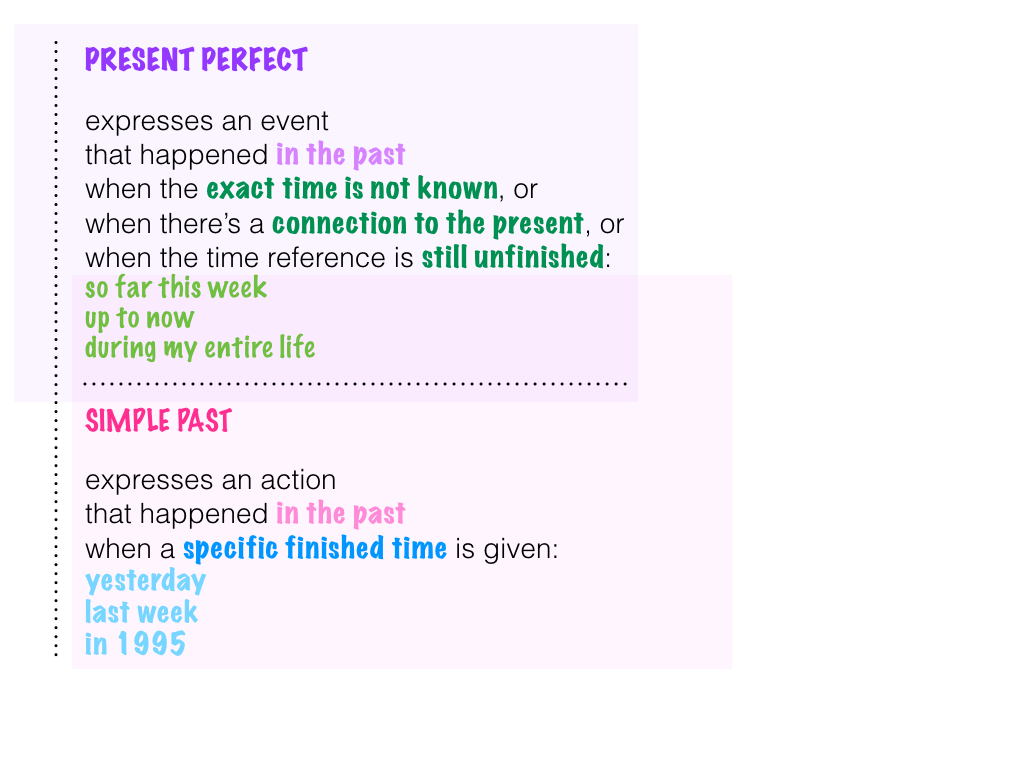


                                            Present Perfect: I, you, we, they have spoken | he, she, it has spoken

                                            Simple Past: I, you, he, she, it, we, they spoke

                                            Sometimes these tenses are interchangeable, depending on what the speaker wishes to emphasize. Here are a few examples:

                                            Julia has returned from her trip. (No specific time is given or is important, and the speaker is emphasizing that Julia is now home.)

                                            Julia returned from her trip. (Perhaps this is part of a longer narration of events in the past.)

                                            I finished reading the novel last night. (“Last night” indicates a specific time in the past.)

                                            Has Pam ever been to New York? (“Even” means “during her entire life.”)

                                            I worked five days last week. (“Last week” is finished time.)

                                            So far this week I’ve worked three days. (“This week” is unfinished time.)
                                            • Practice Exercise 1.1
                                              Complete each of the following sentences with either the Present Perfect or Simple Past Tense.
                                              • 1. Mary  . . . 
                                                drove
                                                her new car to Santa Barbara yesterday.
                                                • has driven
                                                • drive
                                                • drove

                                              • 2. Sam  . . . 
                                                hasn’t tried
                                                on his new pants yet.
                                                • didn’t try
                                                • not try
                                                • hasn’t tried

                                              • 3. We  . . . 
                                                bought
                                                a new house last week.
                                                • have bought
                                                • bought
                                                • buy

                                              • 4.  . . . 
                                                Have you ever eaten
                                                fried bananas?
                                                • Did you ever eat
                                                • Have you ever eaten
                                                • Have you ever ate

                                              • 5. Mr. and Mrs. Denton  . . . 
                                                didn’t go
                                                out of town last weekend.
                                                • haven’t gone
                                                • didn’t go
                                                • not go

                                              • 6. I  . . . 
                                                have never seen
                                                The Birds.
                                                • did never see
                                                • never saw
                                                • have never seen

                                              • 7. He  . . . 
                                                didn’t speak
                                                much English during his trip last April.
                                                • didn’t speak
                                                • not spoke
                                                • haven’t spoken

                                              • 8.  . . . 
                                                Did you miss
                                                me while I was gone?
                                                • Do you missed
                                                • Have you missed
                                                • Did you miss

                                              • 9.  . . . 
                                                Have you ever danced
                                                the salsa?
                                                • Have you ever danced
                                                • Danced you
                                                • Did you ever danced

                                              • 10. Richard  . . . 
                                                got
                                                a new car last week.
                                                • got
                                                • get
                                                • has gotten

                                            • Grammar 1.2
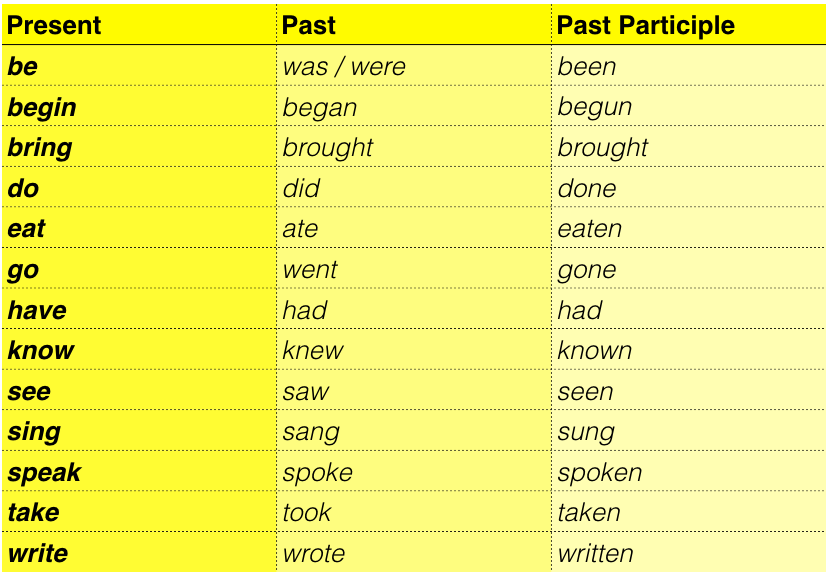
                                              Verbs with Irregular Forms in the Past and Present Perfect Tenses
                                              • A lot of common verbs have irregular simple past and past participial forms. Here are some of the more common ones.
                                              • Practice exercise 1.2
                                                Complete each of the following sentences with correct form of verb.
                                                • 1. Who  . . . 
                                                  sang
                                                  that last song?
                                                  • has sung
                                                  • sing
                                                  • sang

                                                • 2. Sarah  . . . 
                                                  did
                                                  her homework last night.
                                                  • do
                                                  • has done
                                                  • did

                                                • 3. Where  . . . 
                                                  were
                                                  you at breakfast?
                                                  • were
                                                  • been
                                                  • be

                                                • 4. Madeline has already  . . . 
                                                  begun
                                                  her new job.
                                                  • began
                                                  • begun
                                                  • begin

                                                • 5. Henry  . . . 
                                                  knew
                                                  all of the answers.
                                                  • known
                                                  • knew
                                                  • know

                                                • 6. Have you  . . . 
                                                  written
                                                  that letter yet?
                                                  • written
                                                  • write
                                                  • wrote

                                                • 7. Angel  . . . 
                                                  began
                                                  his university education last spring.
                                                  • begun
                                                  • began
                                                  • begin

                                                • 8. She has  . . . 
                                                  sung
                                                  in Las Vegas many times.
                                                  • sing
                                                  • sung
                                                  • song

                                                • 9. Has anyone really ever  . . . 
                                                  seen
                                                  Big Foot?
                                                  • seen
                                                  • see
                                                  • saw

                                                • 10. I had a headache, so I  . . . 
                                                  took
                                                  some aspirin.
                                                  • took
                                                  • taken
                                                  • take

                                              • Grammar 1.3
                                                Using for and since with the Present Perfect and Simple Past Tenses.

                                                Use since when a specific point in time is given:
                                                since yesterday
                                                since last week
                                                since last month
                                                Richard has lived in Chicago since 1995.

                                                Use for when a period of time is given:
                                                for one day
                                                for a week
                                                for three months
                                                Richard has lived in Chicago for twenty years.

                                                Note: You can use for and since with either the Simple Past Tense or the Present Perfect Tense, depending on whether or not the action is still happening:
                                                I’ve worked for Green Enterprises for three years. (I still work there.)
                                                I worked for Green Enterprises for three years. (Now I work somewhere else.)
                                                • Practice exercise 1.3
                                                  Complete each sentence with either since or for.
                                                  • 1. We’ve lived in Los Angeles  . . . 
                                                    since
                                                    before Barry was born.
                                                    • for
                                                    • since

                                                  • 2. We’ve lived in Los Angeles  . . . 
                                                    for
                                                    ten years.
                                                    • since
                                                    • for

                                                  • 3. There’s been a roadblock on the freeway  . . . 
                                                    for
                                                    three days.
                                                    • since
                                                    • for

                                                  • 4. I haven’t seen you  . . . 
                                                    since
                                                    I was in high school.
                                                    • since
                                                    • for

                                                  • 5. Why haven’t you called  . . . 
                                                    for
                                                    two weeks?
                                                    • since
                                                    • for

                                                  • 6. Susan hasn’t gone to work  . . . 
                                                    since
                                                    last Tuesday.
                                                    • since
                                                    • for

                                                  • 7. They stayed at this hotel  . . . 
                                                    for
                                                    three nights.
                                                    • for
                                                    • since

                                                  • 8. Roger and Martin have been gone  . . . 
                                                    for
                                                    hours!
                                                    • for
                                                    • since

                                                  • 9. Have you been waiting for me  . . . 
                                                    since
                                                    7:30?
                                                    • since
                                                    • for

                                                  • 10. She hasn’t spoken to me  . . . 
                                                    since
                                                    the night we got into an argument.
                                                    • for
                                                    • since

                                                • Phrasal verbs with PICK.
                                                  • Pick up

                                                    • • To take something up off of a surface. —  . . . 
                                                      Pick
                                                      your coat  . . . 
                                                      up
                                                      off the floor.

                                                      • • To meet and collect a person from a specific location. — Who’s going to  . . . 
                                                        pick
                                                        Henry  . . . 
                                                        up
                                                        at the airport?

                                                        • • To buy something. — Jordan  . . . 
                                                          picked up
                                                          some milk on the way home.

                                                          • Note: To pick up a person can also mean to meet someone, usually at a public place such as a bar or night club, and to become sexually involved with him or her after spending only a short time together.

                                                            • Pick out

                                                              • • To select, to choose. — Melissa  . . . 
                                                                picked out
                                                                a shirt and brought it to the dressing room.

                                                                • • To separate from. — If you break a wine glass, make sure you  . . . 
                                                                  pick
                                                                  all of the glass  . . . 
                                                                  out
                                                                  of the carpet.

                                                                  • Pick over

                                                                    • • To take the best of something and leave what is not so good. — The shirts have been on sale so long that they’ve really been  . . . 
                                                                      picked over
                                                                      .

                                                                      • Pick on

                                                                        • • To tease. — My sisters and brothers always  . . . 
                                                                          picked on
                                                                          me because I was the youngest.

                                                                          • Pick from

                                                                            • • To choose from a group of something. — Mrs. Stefansson  . . . 
                                                                              picked
                                                                              a new assistant  . . . 
                                                                              from
                                                                              the group of applicants for the job.

                                                                              • Pick at

                                                                                • • To take only very small amounts of food. — Jessica ate almost everything on her plate, but she only  . . . 
                                                                                  picked at
                                                                                  her peas.

                                                                                  • • To scratch or irritate something, such as a cut or scrape. — Don’t  . . . 
                                                                                    pick at
                                                                                    that cut! Let it heal.

                                                                                    • Pick up on

                                                                                      • • To understand something, especially something that isn’t intended to be understood. — They spoke in Spanish in front of Dorothy, so she didn’t  . . . 
                                                                                        pick up on
                                                                                        what they were talking about.

                                                                                        • Note: Pick up, pick out, pick from, and pick over are separable. This mean the two words can be separated and a pronoun or noun can be inserted between them. — Billy picked out the raisins or Billy picked them/raisins out but not Billy picked out them.
                                                                                          Pick on, pick at, and pick up on are not separable. You cannot separate the verbs from the prepositions.

                                                                                        • Real English — See you later!
                                                                                          • Saying “good-buy!” is only one way to end a conversation. There are a lot of idiomatic expressions that people use when a conversation is over or when they have to leave. Here are some important ones, listed from most to least formal:
                                                                                            Have a good day.
                                                                                                  Take care.
                                                                                                  Take it easy.
                                                                                                  See you later.
                                                                                                  See you around.
                                                                                                  See ya!
                                                                                                  Catch you later.
                                                                                                  Gotta go.
                                                                                            Note: These expressions are often preceded with well. — Well, have a nice day!

                                                                                          • Review exercise 1 — I.N.S Vocabulary.
                                                                                            Place the correct vocabulary word in each space. Use each of the following words once.
                                                                                            • •      solicit       •      beneficiary       •      indicted       •      procured       •      waiver       •      persecuted       •      Incited       •      affiliation       •      espionage       •      Amnesty       •      conspired       •      rehabilitation       •      clemency       •      sabotage       •      cited       •      induce       •      fraud       •      custody       •      ordinance       •      engaging

                                                                                              • 1. When we found out that Dr. Wells hadn’t gone to medical school, we knew he was a .

                                                                                                • 2. Learning new skills is essential to the successful from a life of crime.

                                                                                                  • 3. For some people, working is much harder than in crime.

                                                                                                    • 4. The well-known International is an organization dedicated to encouraging governments to free their political prisoners.

                                                                                                      • 5. Bill Jackson felt because he had received a dishonorable discharge from the army and few employers would hire him.

                                                                                                        • 6. The soldiers sneaked in behind enemy lines to the next shipment of weapons.

                                                                                                          • 7. by jealousy, Roberto accused his wife of having an affair.

                                                                                                            • 8. If you let your dog walk around without a leash, you are violating a city.

                                                                                                              • 9. I want to show you some new gems we’ve recently .

                                                                                                                • 10. The senator was forced to resign when his with a racist organization was uncovered.

                                                                                                                  • 11. A sixteen-year-old cannot attend adult school without a from high school.

                                                                                                                    • 12. Tammy went to several companies to money so that she could afford to travel to the swimming competition.

                                                                                                                      • 13. Ralph was for breaking and entering.

                                                                                                                        • 14. Mary was for driving with her lights off.

                                                                                                                          • 15. The Rangels filed for of their daughter’s son.

                                                                                                                            • 16. A governor has the power to give to a condemned criminal, commuting a death sentence to life in prison.

                                                                                                                              • 17. The boys to scare all the girls in class on Halloween.

                                                                                                                                • 18. Wiretaps were placed on the ambassador’s phone line in an act of .

                                                                                                                                  • 19. Tony named his wife, Susan, as the on his life insurance policy.

                                                                                                                                    • 20. The labels of many poisonous products warn not to vomiting in case of accidental ingestion.

                                                                                                                                    • Review exercise 2 — The Present Perfect Tense vs. the Simple Past Tense.
                                                                                                                                      Complete each of the following sentences with the correct form of the verb.
                                                                                                                                      • 1. The plane  . . . 
                                                                                                                                        arrived
                                                                                                                                        on time yesterday, but traffic was awful.
                                                                                                                                        • has arrived
                                                                                                                                        • arrived

                                                                                                                                      • 2. It  . . . 
                                                                                                                                        has been
                                                                                                                                        a long hot summer, and it’s only August 3!
                                                                                                                                        • was
                                                                                                                                        • has been

                                                                                                                                      • 3. No one can believe he  . . . 
                                                                                                                                        hasn’t called
                                                                                                                                        you yet.
                                                                                                                                        • hasn’t called
                                                                                                                                        • called

                                                                                                                                      • 4. Who  . . . 
                                                                                                                                        put
                                                                                                                                        my keys under the couch last night?
                                                                                                                                        • put
                                                                                                                                        • has put

                                                                                                                                      • 5. We  . . . 
                                                                                                                                        ate
                                                                                                                                        dinner at six.
                                                                                                                                        • ate
                                                                                                                                        • have eaten

                                                                                                                                      • 6. Christian  . . . 
                                                                                                                                        has gone
                                                                                                                                        to school already this morning.
                                                                                                                                        • has gone
                                                                                                                                        • went

                                                                                                                                      • 7. We  . . . 
                                                                                                                                        visited
                                                                                                                                        the Metropolitan Museum when we were in New York.
                                                                                                                                        • visited
                                                                                                                                        • have visited

                                                                                                                                      • 8. I  . . . 
                                                                                                                                        have seen
                                                                                                                                        the Eiffel Tower several times, but never in the spring.
                                                                                                                                        • have seen
                                                                                                                                        • saw

                                                                                                                                    • Review exercise 3 — Irregular Verb Forms
                                                                                                                                      Fill in the spaces with the missing verb forms.
                                                                                                                                      • 1) present: | past: was / were | past participle:

                                                                                                                                        • 2) present: do | past: | past participle:

                                                                                                                                          • 3) present: | past: | past participle: gone

                                                                                                                                            • 4) present: | past: gave | past participle:

                                                                                                                                              • 5) present: | past: ate | past participle:

                                                                                                                                                • 6) present: write | past: | past participle:

                                                                                                                                                  • 7) present: | past: | past participle: begun

                                                                                                                                                    • 8) present: | past: |past participle: seen

                                                                                                                                                    • Preview exercise 4 — For and Since
                                                                                                                                                      Fill in each sentence with since or for.
                                                                                                                                                      • 1. I don’t think I’ve seen you  . . . 
                                                                                                                                                        since
                                                                                                                                                        high school.
                                                                                                                                                        • since
                                                                                                                                                        • for

                                                                                                                                                      • 2. They didn’t speak to each other  . . . 
                                                                                                                                                        for
                                                                                                                                                        several weeks.
                                                                                                                                                        • since
                                                                                                                                                        • for

                                                                                                                                                      • 3. How long has it been  . . . 
                                                                                                                                                        since
                                                                                                                                                        you left?
                                                                                                                                                        • since
                                                                                                                                                        • for

                                                                                                                                                      • 4. We haven’t spoken  . . . 
                                                                                                                                                        for
                                                                                                                                                        three years!
                                                                                                                                                        • for
                                                                                                                                                        • since

                                                                                                                                                      • 5. Why did you keep silent  . . . 
                                                                                                                                                        for
                                                                                                                                                        so many months?
                                                                                                                                                        • since
                                                                                                                                                        • for

                                                                                                                                                      • 6. I can’t believe you’ve been in Boston  . . . 
                                                                                                                                                        since
                                                                                                                                                        September!
                                                                                                                                                        • for
                                                                                                                                                        • since

                                                                                                                                                      • 7. I’m not sure why he hasn’t called  . . . 
                                                                                                                                                        since
                                                                                                                                                        last week.
                                                                                                                                                        • since
                                                                                                                                                        • for

                                                                                                                                                      • 8. It hasn’t rained  . . . 
                                                                                                                                                        for
                                                                                                                                                        six months.
                                                                                                                                                        • since
                                                                                                                                                        • for

                                                                                                                                                    • Review exercise 5 — Phrasal Verbs
                                                                                                                                                      Place the correct phrasal verb with pick in the blank space in each sentence.
                                                                                                                                                      • 1. What time do you want me to you from the airport?

                                                                                                                                                        • 2. Alex’s mother and sister helped her her wedding dress.

                                                                                                                                                          • 3. Look how you your food. You eat like a bird.

                                                                                                                                                            • 4. Johnny, all your toys and put them away.

                                                                                                                                                              • 5. Evelyn the label on her sweater because it irritates her.

                                                                                                                                                                • 6. Mrs. Russell told the class bully not to the younger children.

                                                                                                                                                                  • 7. Barry’s a pretty smart little boy; he seems to whatever anyone says.

                                                                                                                                                                    • 8. I’ve a beautiful crystal vase for Bill and Cindy’s wedding gift.

                                                                                                                                                                    • Greetings and Small Talk
                                                                                                                                                                      • Have you ever heard a complete stranger say hello to you as you pass him or her on the street? Don’t worry. That’s not unusual. Americans often greet people they don’t even know. They may talk to strangers while waiting in line, or comment on the weather when standing in an elevator, or even strike up a conversation while sitting next to someone at a public event. It’s true that this kind of behavior may seem too casual — or even just plain strange — toothers, but many Americans consider it friendly. Of course, these little pieces of “small talk” aren’t meant to discuss anything very serious or personal or make new friendships. When they end, the participants go their separate ways and rarely commit to any kind of social involvement. This is normal for Americans, who often have a lot of acquaintances — at work, in their neighborhoods, at stores and restaurants, at the gym. But Americans also make an important distinction between casual acquaintances and close friends.

                                                                                                                                                                      arrow_backarrow_forward
                                                                                                                                                                      © 2020 DrillPal.com