


Nov 22, 2016
- Answer the questions below
- The mid-ocean ridge occurs along a “ . . . ”
- Transform boundary where crust is subducted
- Divergent boundary where subduction takes place
- Convergent boundary where new crust is formed
- Divergent boundary where sea-floor spreading takes place
- The place where two plates collide is called a “ . . . ”
- Hot spot
- Transform boundary
- Divergent boundary
- Convergent boundary
- Hot spots are “ . . . ”
- Constantly disappearing and reappearing
- Stationary, they stay in the same place
- What creates earthquakes
- Always moving around
- Subduction is when “ . . . ”
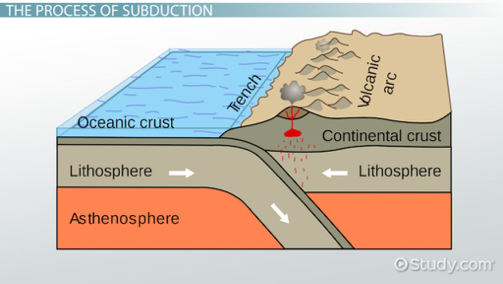
- New crust is formed
- Earthquakes occur along a transform boundary
- One plate slides under another
- New islands are formed
- The fact that ice floats on top of water is like the fact that “ . . . ”
- The less dense crust sits on top of the mantle
- The crust is melting
- The mantle is colder than the crust
- The mantle causes earthquakes and volcanoes
- The theory that continents are slowly moving over Earth’s surface is called “ . . . ”
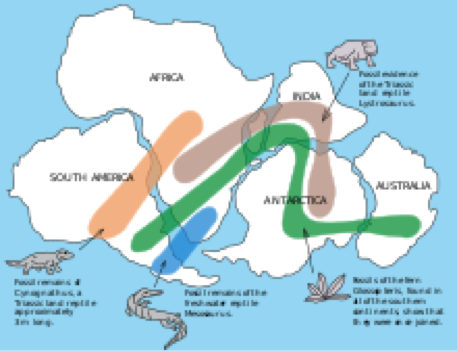
- The theory of Pangaea
- The theory of plate boundaries
- The theory of continental drift
- The theory of plate tectonics
- Continental crust is “ . . . ” than oceanic crust
- Hotter
- Colder
- Thinner
- Thicker
- What causes the tectonic plates to move?
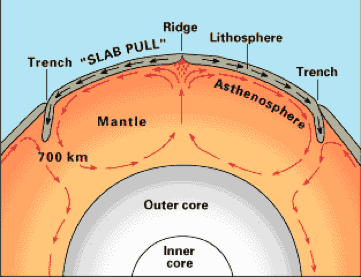
- Convection in the mantle
- Volcanoes
- Ocean currents
- The Coriolis effect
- The Himalayan mountains were formed because of a “ . . . ”
- Hot spot
- Convergent boundary
- Transform boundary
- Divergent boundary
- A place where an unusually hot part of the mantle rises through the crust causing volcanic activity is called a “ . . . ”
- Convergent boundary
- Divergent boundary
- Hot spot
- Transform boundary
- What was the name of the theory that separated the continents?
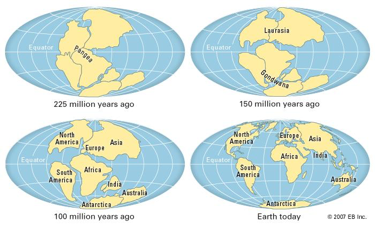
- Plate Tectonics
- Subduction
- Ring of fire
- Continental Drift
- The theory that states that pieces of Earth's crust are in constant, slow motion driven by movement in the mantle is called “ . . . ”
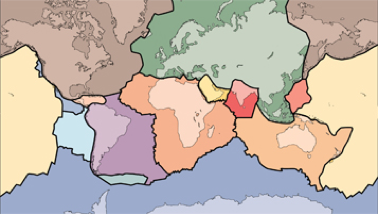
- The theory of plate boundaries
- The theory of plate tectonics
- The theory of continental drift
- The theory of Pangaea
- The ring of fire is a ring of volcanoes and earthquakes that occur along “ . . . ”
- Only transform boundaries
- Plate boundaries
- The mid-ocean ridge
- Hot spots
- Pieces of Earth's crust move on top of the “ . . . ”
- Mantle
- Outer core
- Inner core
- Ocean
- A map of global earthquakes and volcanoes tells you “ . . . ”
- Where the plate boundaries are
- Where the earth is the hottest
- Where the edges of the continents are
- Nothing, it looks random
- Oceanic crust is “ . . . ” than continental crust
- More dense
- Less hot
- Less dense
- More hot
- The process that continually adds new crust is “ . . . ”
- Subduction
- Convection
- Earthquakes
- Sea-floor spreading
- Volcanoes are most likely to occur along a “ . . . ”
- Sea-floor spreading
- Transform boundary
- Divergent boundary
- Convergent boundary
- Where two plates rub past each other in opposite directions is a “ . . . ”
- Convergent boundary
- Hot spot
- Transform boundary
- Divergent boundary
- When two continental plates pull apart a “ . . . ” forms.
- Earthquake
- Subduction zone
- Mountain range
- Rift valley
- The place where two plates move apart is called a “ . . . .”
- Divergent boundary
- Transform boundary
- Convergent boundary
- Hot spot
- The mid-ocean ridge occurs along a “ . . . ”
arrow_backarrow_forward
© 2020 DrillPal.com