


Jan 4, 2016
- Directions: These sample questions in the Reading section measure your ability to understand academic passages in English. You will read one passage and answer questions about it. In a real test, you would have 20 minutes to read the passage and answer the questions. Candidates with disabilities may request a time extension.
- The word “pose” [1] is closest in meaning to:
- claim
- assume
- present
- model
- In paragraph 2, why does the author include the information that dinosaurs had flourished for tens of millions of years and then suddenly disappeared?
- To explain why as many as half of the species on Earth at the time are believed to have become extinct at the end of the Cretaceous
- To provide evidence that an impact can be large enough to disturb the environment of the entire planet and cause an ecological disaster
- To explain why paleontologists have always been intrigued by the mass extinction at the end of the Cretaceous
- To support the claim that the mass extinction at the end of the Cretaceous is the best-documented of the dozen or so mass extinctions in the geological record
- Which of the following can be inferred from paragraph 3 about the location of the meteorite impact in Mexico?
- The location of the impact site in Mexico was kept secret by geologists from 1980 to 1990.
- It was a well-known fact that the impact had occurred in the Yucatán region.
- Geologists knew that there had been an impact before they knew where it had occurred.
- The Yucatán region was chosen by geologists as the most probable impact site because of its climate.
- According to paragraph 3, how did scientists determine that a large meteorite had impacted Earth?
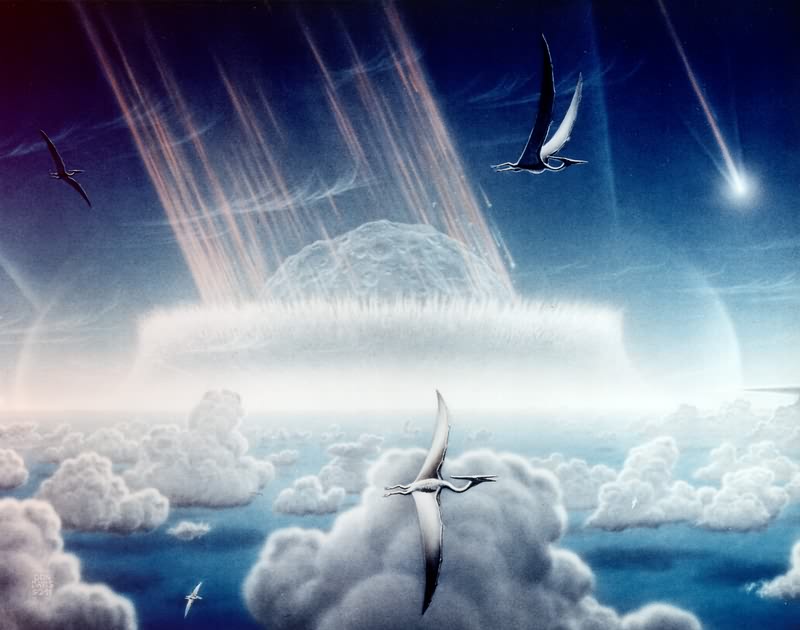
- They discovered a large crater in the Yucatán region of Mexico.
- They found a unique layer of sediment worldwide.
- They were alerted by archaeologists who had been excavating in the Yucatán region.
- They located a meteorite with a mass of over a trillion tons.
- The word “excavating” [2] is closest in meaning to:
- digging out
- covering up
- extending
- destroying
- The word “consumed” [3] is closest in meaning to:
- changed
- destroyed
- covered
- exposed
- According to paragraph 4, all of the following statements are true of the impact at the end of the Cretaceous period EXCEPT:
- Large quantities of nitric acid were produced.
- Earth became cold and dark for several months.
- New elements were formed in Earth’s crust.
- A large amount of dust blocked sunlight from Earth.
- The phrase “tentatively identified” [4] is closest in meaning to:
- identified after careful study
- easily identified
- occasionally identified
- identified without certainty
- The word “perspective” [5] is closest in meaning to:
- sense of values
- point of view
- calculation
- complication
- Paragraph 6 supports which of the following statements about the factors that are essential for the survival of a species?
- Since most extinctions of species are due to major meteorite impacts, the ability to survive such impacts is the most important factor for the survival of a species.
- The most important factor for the survival of a species is its ability to compete and adapt to gradual changes in its environment.
- The factors that are most important for the survival of a species vary significantly from one species to another.
- The ability of a species to compete and adapt to a gradually changing environment is not the only ability that is essential for survival.
- Which of the sentences below best expresses the essential information in the following sentence?
Earth is a target in a cosmic shooting gallery, subject to random violent events that were unsuspected a few decades ago.
Answer choices:- A few decades ago, Earth became the target of random violent events originating in outer space.
- In the last few decades, the risk of a random violent impact from space has increased.
- Since most violent events on Earth occur randomly, nobody can predict when or where they will happen.
- Until recently, nobody realized that Earth is exposed to unpredictable violent impacts from space.
- According to the passage, who conducted investigations about the current dangers posed by large meteorite impacts on Earth?
- Paleontologists
- Geologists
- The United States Congress
- NASA
- Look at the four letters (A, B, C, and D) that indicate where the following sentence could be added to the passage in paragraph 6.
This is the criterion emphasized by Darwin’s theory of evolution by natural selection.
Impacts by meteorites represent one mechanism that could cause global catastrophes and seriously influence the evolution of life all over the planet. (A) According to some estimates, the majority of all extinctions of species may be due to such impacts. (B) Such a perspective fundamentally changes our view of biological evolution. (C) The standard criterion for the survival of a species is its success in competing with other species and adapting to slowly changing environments. (D) Yet an equally important criterion is the ability of a species to survive random global ecological catastrophes due to impacts.
Choose the place where the sentence fits best.- Option C
- Option A
- Option B
- Option D
- An introductory sentence for a brief summary of the passage is provided below. Complete the summary by selecting the THREE answer choices that express the most important ideas in the passage. Some sentences do not belong in the summary because they express ideas that are not presented in the passage or are minor ideas in the passage.
Scientists have linked the mass extinction at the end of the Cretaceous with a meteorite impact on Earth.
Answer choices:- Large meteorite impacts, such as one at the end of the Cretaceous period, can seriously affect climate, ecological niches, plants, and animals.
- Scientists had believed for centuries that meteorite activity influenced evolution on Earth.
- An iridium-enriched sediment layer and a large impact crater in the Yucatán provide evidence that a large meteorite struck Earth about 65 million years ago.
- The site of the large meteorite impact at the end of the Cretaceous period was identified in 1990.
- There have also been large meteorite impacts on the surface of the Moon, leaving craters like Tycho.
- Meteorite impacts can be advantageous for some species, which thrive, and disastrous for other species, which become extinct.
© 2020 DrillPal.com