


Feb 10, 2016
- EARLY NASWA: Ancient Kush (6.2.8)
- The pyramids of Kush were similar to those of Egypt, the difference was . . . .
- that they were temples not burial places
- not noticeable
- that they had no way of entry
- that they were smaller with steeper sides
- After Egypt was defeated by the Assyrians, Kush became known for its . . . and . . . throughout the Mediterranean and Indian Ocean.
- warriors | victories
- tools | traded it
- pyramids | architecture
- iron work | irrigation
- The early Kush civilizations were known for their great . . . ; they were so great at times Egypt would use them as . . . .
- iron tools | iron workers
- warriors | builders
- pyramids | mercenaries
- gods and goddesses | their own
- The pyramids of Kush were similar to those of Egypt, the difference was . . . .
- EARLY NASWA: Egyptian Pharaohs (6.2.3, 6.2.7)
- Ramses II, also known as Ramses the Great, . . . .
- built many temples including Abu Simbel
- ruled at time when Egypt was weak
- was one of the first pharaohs to build a pyramid
- was not interested in honoring himself with monuments
- Which of the following describes how power was transferred from one Pharaoh to another?
- When a Pharaoh died, power usually passed to his son.
- When people were unhappy with the Pharaoh they could elect a new one.
- When a Pharaoh died there was an election.
- When a Pharaoh died his wife took power.
- Which of the following is a significant event involving Queen Hatshepsut?
- She was in power for 14 years.
- She was known for trying to start a war with the tribes of Kush.
- She was the second female ruler in Ancient Egyptian times.
- She disappeared suddenly and may have been murdered by her son.
- Ramses II, also known as Ramses the Great, . . . .
- EARLY NASWA: Legal Systems (6.2.3, 6.2.4)
- Though most of Babylonia’s citizens could not read, Hammurabi’s Code was still significant because . . . .
- the laws only dealt with religious matters
- the laws were only kept in Hammurabi’s palace
- the laws were made available to the public
- it was the first set of laws
- Egyptian kings were commonly known as . . . .
- artisans
- priests
- pharaohs
- nomads
- What was Hammurabi’s Code?
- The law of West Africa.
- The law of the ancient Chinese.
- The first recorded laws in Mesopotamia.
- The first recorded laws in Egypt.
- Who were the leaders of the city-states in Mesopotamia?
- priests
- kings
- merchants
- pharaohs
- Which answer BEST describes what has enabled modern Historians to learn so much about the ancient Code of Hammurabi?
- It was the first list of laws written.
- It was a complete and organized set of laws.
- It was written on a black stone monument.
- It was the best list of laws ever written.
- The Code of Hammurabi is best known for the idea of . . . .
- mandatory military service
- city-states
- an eye for an eye
- Which of the following BEST supports the statement that the earliest government in Mesopotamia was a theocracy?
- The king was elected by the people.
- The king had limited power.
- The king was honored as a God.
- The king was considered a representative of God.
- One of the benefits of Hammurabi’s code was that it assisted in … (Select all that apply.)
- providing stability in the region following a troubling time
- achieving unity in the Babylonian empire
- transforming Babylon into the central power of Mesopotamia
- Though most of Babylonia’s citizens could not read, Hammurabi’s Code was still significant because . . . .
- ANCIENT GREECE: Persian Empire (6.4.5)
- Each province in the Persian Empire was ruled by a . . . , or governor.
- ayatollah
- satrap
- shah
- cleric
- Persian King . . . added the most territory to the Persian Empire.
- Xerxes
- Cyrus the Great
- Cambyses
- Darius
- Which statement best describes Cyrus’ treatment of the Jewish people in the Persian Empire?
- The Jews were allowed to practice their religion.
- The Jews were forbidden to own copies of the Old Testament.
- The Jews were expelled from the Persian Empire.
- The Jews were forced to work on the Royal Road.
- Which of the following people defeated the Medes and Babylonians to create the FIRST Persian Empire?
- Darius the Great
- Cambyses II
- Xerxes
- Cyrus the Great
- Each province in the Persian Empire was ruled by a . . . , or governor.
- ANCIENT GREECE: Alexander the Great (6.4.7)
- Alexander the Great began his conquest to the east by defeating what powerful nation?
- England
- Persia
- Russia
- Egypt
- After Alexander the Great’s death, Greek influence continued in the lands bordering the Mediterranean Sea. Which of the following is the BEST example of this widespread influence?
- Other countries adopted the Greek sport of chariot racing.
- People began to worship one god like the Greeks did.
- The use of hieroglyphics was used in many countries.
- Traders used the Greek language in every land.
- Education helped Alexander the Great in his rise to power. As a boy, Alexander studied under a famous philosopher. What was this philosopher’s name?
- Plato
- Aristotle
- Asthenia
- Albert Einstein
- Alexander the Great’s conquests spread the Greek culture and influence far and wide. One example of this could be found in the city of Petra, now in Jordan, where many buildings were designed after the Greek style.
Which of the following is an example of Greek architecture?- Doric, Corinthian and Ionic columns
- Pyramid type structures
- The Colosseum, a circular theater
- Stonehenge
- Which of the following is NOT a reason why Alexander the Great and his army defeated the Persians?
- The Persian army was unorganized and defeated after one year of battle.
- Alexander the Great and his army was twice the size of the Persian army.
- Alexander the Great had well trained and fierce soldiers.
- Alexander the Great and his army were much smaller than the Persian army.
- Alexander the Great began his conquest to the east by defeating what powerful nation?
- ANCIENT GREECE: City States & Wars (6.4.6)
- The ending of the Peloponnesian War had which of the following effects on Greek society?
- democracy flourished in Athens
- decreased corruption in Athenian politics
- All answer choices
- ended the “Golden Age” of Athens
- Athens and Sparta were both Greek city states. In what major way were they different?
- Sparta was a trading center governed by foreigners while Athens was an educational center governed by philosopher kings.
- Athens was a commercial state governed by merchants while Sparta was a sporting center governed by athletes.
- Sparta was a military state governed by soldiers while Athens was a cultural and intellectual center governed by direct democracy.
- Athens was a military state governed by soldiers while Sparta was a cultural and intellectual center governed by direct democracy.
- Sparta and Athens joined forces and defeated the . . . .
- Persians
- Romans
- Egyptians
- Greeks
- The ending of the Peloponnesian War had which of the following effects on Greek society?
- ANCIENT INDIA: Art & Literature (6.5.7)
- Suppose you were translating one of the first written copies of the Bhagavad Gita. One skill you would need to understand the text is to be able to translate ancient . . . .
- Chinese.
- Sumerian.
- Sanskrit.
- Hebrew.
- The system of Arabic numerals adopted by Western Europeans was originally created by the . . . .
- Romans
- Saudi Arabia
- Chinese
- Indians
- Which of the following was used for both medicine and metal extraction during ancient Indian times?
- gold
- bronze
- zinc
- Damascus steel
- Suppose you were translating one of the first written copies of the Bhagavad Gita. One skill you would need to understand the text is to be able to translate ancient . . . .
- ANCIENT INDIA: Buddhism (6.5.5)
- The teachings of Siddhartha Gautama inspired the founding of which religion?
- Buddhism
- Hinduism
- None of the answer choices
- Islam
- In Buddhism, the ultimate goal of life is BEST described as . . . .
- pain
- enlightenment
- sacrifice
- desire
- The teachings of Siddhartha Gautama inspired the founding of which religion?
- ANCIENT INDIA: Maurya Empire (6.5.6)
- Feeling grief after his conquest of the Decca Region of Kalinga, Emperor Asoka converted to which of the following religions?
- Hinduism
- Buddhism
- Christianity
- Islam
- At the height of the Maurya Empire, the boundaries of the civilization had grown to encompass what present day country?
- Indonesia
- Iraq
- Iran
- India
- Feeling grief after his conquest of the Decca Region of Kalinga, Emperor Asoka converted to which of the following religions?
- DYNASTIC CHINA: Geography & Daily Life (6.6.1, 6.6.2)
- Which letter on the map below is the location of the Huang He and the early civilization it supported?
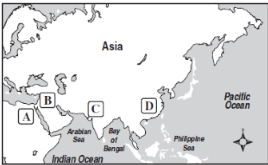
- location C
- location D
- location B
- location A
- What kind of artifacts from the Shang Dynasty were found by archaeologists in the Huang He Valley?
- many early gold and bronze coins and bronze coin boxes
- very beautiful cave paintings of animals
- the remains of books and early printing presses
- building foundations, walls, and tombs containing jade and bronze
- Which of the following geographical features contributed to China’s isolation from the rest of the world?
- The Huang He and Chang Jiang rivers
- The plateaus in central China
- The mountain ranges on its west and north
- The floodplains
- The metal smiths of the Shang dynasty were skilled in working with . . . .
- aluminum
- carbon steel
- bronze
- copper
- What geographic features of China separated its people from the rest of the world and made a central government very difficult?
- great distances between cities
- All answer choices
- rivers
- deserts and mountains
- Suppose you lived in ancient China and wanted to trade goods with people in Mongolia. What would make such an exchange difficult to do?
- The fact that Mongolia is separated from China by a long river.
- The fact that Mongolia is on a different continent.
- The fact that the land between China and Mongolia is comprised of vast tundra.
- The fact that a large desert separates China from Mongolia.
- The map below shows Asia with four rivers labeled A, B, C, and D.
Which letter on the map marks the location of the Haung He (Yellow) River?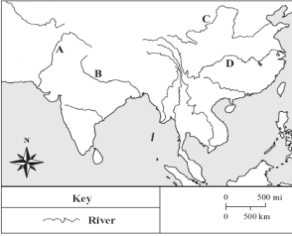
- label A
- label C
- label D
- label B
- The early Chinese were so isolated by the geography of the land that they came to believe that . . . .
- Chinese culture was vastly superior to all others
- China was the center of “all under heaven”
- China was the only country in the world
- Chinese people had come from the moon
- Early Chinese civilizations developed in eastern China around which of the following rivers?
- Brahmaputra
- Huang He
- Indus
- Si
- China’s eastern coast was isolated from Western China and the rest of the Western world by what landform?
- North China Plain
- Huang He River
- Altay Mountains
- Gobi Desert
- Which letter on the map below is the location of the Huang He and the early civilization it supported?
- DYNASTIC CHINA: Qin Dynasty (6.6.5)
- Why did Emperor Qin Shi Huang bury over 6,000 terracotta soldiers in his tomb?
- He created an entire army of terracotta soldiers to protect him in the afterlife.
- He was afraid enemies would destroy this great art.
- The soldiers were a gift to the Emperor.
- He had a deep interest in art and sculpture and wanted to take them with to the afterlife.
- Qin Shi Huang removed what system of government from China to unite the country?
- feudalism
- authoritarian
- democracy
- centralized
- Why did Emperor Qin Shi Huang bury over 6,000 terracotta soldiers in his tomb?
- DYNASTIC CHINA: Shang Dynasty (6.6.1)
- Early Chinese civilizations developed in eastern China around which of the following rivers?
- Huang He
- Brahmaputra
- Si
- Indus
- The first written Chinese characters appeared in the Huang He valley at the time of the Shang dynasty. Which of the following is a true statement about the first Chinese writing system?
- Each Chinese character represents one whole word.
- The Chinese alphabet has 326 letters.
- The Chinese used the abacus for writing.
- Chinese writing was always from the bottom of the page to the top.
- Early Chinese civilizations developed in eastern China around which of the following rivers?
arrow_backarrow_forward
© 2020 DrillPal.com