


Feb 10, 2016
- EARLY HUMANS: Paleolithic Culture (6.1)
- Homo sapiens means “ . . . ”.
- tool holder
- wise human
- cave dweller
- thinker
- Early people stopped roaming with the . . . .
- discovery of iron
- building of aqueducts
- invention of the wheel
- development of agriculture
- How did early human adaptation lead to migration to the Americas?
- Early humans followed mammals they hunted across the Bering Land Bridge.
- Early humans needed the wood for fire in the Americas.
- Early humans supplemented food sources by planting seeds along their path to the Americas.
- Early humans believed that their leader would transport them to the Americas.
- Which activity would a hunter-gatherer MOST likely participate in during the Old Stone Age?
- domesticating animals
- writing letters to close relatives
- scattering seeds onto farm fields
- using tools to butcher: (cut up) game: (animals)
- Which activity would a hunter-gatherer MOST likely participate in during the Old Stone Age?
- scattering seeds onto farm fields
- domesticating animals
- using tools to butcher: (cut up) game: (animals)
- writing letters to close relatives
- Homo sapiens means “ . . . ”.
- EARLY NASWA: Egyptian Culture (6.2.5, 6.2.9)
- Which of the following BEST completes the statement?
The ancient written language hieroglyphics began as . . . .- cave paintings
- pictures that represented objects or ideas
- an Egyptian alphabet
- wedge shaped cuts on clay that represented sounds
- Many of the gods and goddesses in Egyptian art had animal heads and human bodies. Anubis was a . . . headed god that helped guide the dead into the afterlife.
- cat
- jackal
- snake
- beetle
- Hieroglyphics and cuneiform were . . . .
- ancient Babylonian art
- forms of architecture
- ancient systems of writing
- warfare methods practiced by the Sumerians
- Which of the following terms does not apply to writing?
- cuneiform
- hieroglyph
- scribe
- ziggurat
- What is the primary function of this Egyptian structure?
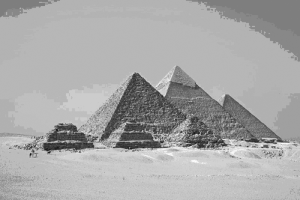
- to serve as a museum for lavish art work
- to use as a grain storage
- to protect Egyptians against surprise attacks from foreign invaders
- to provide a resting place for deceased high officials
- Which answer BEST explains what size differences in Egyptian pyramids were meant to represent?
- the person’s behavior while they were alive
- social status
- who the builder was
- gender of the inhabitant
- In Egyptian art, what did humans with animal heads represent?
- a sacred animal to the Egyptians
- a god or person with supernatural qualities
- the ruling period of a pharaoh
- the human had been sacrificed to that animal
- Cuneiform, the earliest form of writing, was developed by . . . .
- Egyptians.
- Sumerians.
- Romans.
- Greeks.
- Which skill was MOST critical in the building of pyramids in ancient Egypt?
- logging
- bronze making
- hunting
- stonemasonry
- People in Ancient Mesopotamia used a form of written language called . . . .
- Cuneiform
- Hieroglyphics
- Cave Painting
- Papyrus
- Which of the following BEST completes the statement?
- ANCIENT GREECE: Geography & Daily Life (6.4.1)
- A city-state is . . . .
- a city in a state
- a city and the surrounding areas with its own independent government
- a city with its own government
- a major city in a country
- The ancient Greeks were unable to farm their rocky terrain and turned to the Aegean Sea . . . .
- to fish and form trade routes to surrounding countries
- as a source of the fountain of youth
- to mine for silver and gold to trade with other countries
- to build a Navy to conquer countries that had farmland
- The map below shows the location of which civilization?
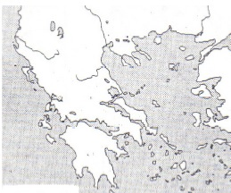
- Mesopotamia
- Greece
- Egypt
- India
- A city-state is . . . .
- ANCIENT GREECE: Literature and Mythology
- The term “Trojan horse” often refers to trick played on an enemy. The horse is mentioned in a story about the Trojan War written by . . . .
- Aesop
- Achilles
- Homer
- Aristotle
- Atlas — a collection of maps.
Herculean — very powerful.
Labyrinth — a maze.
Olympian — majestic, honored.
All of these words used in the English Language today originated in myths of the . . . .- Romans
- Greeks
- Chinese
- Egyptians
- The term “Trojan horse” often refers to trick played on an enemy. The horse is mentioned in a story about the Trojan War written by . . . .
- ANCIENT GREECE: Athenian Democracy (6.4.2, 6.4.3)
- What is the best definition of an oligarchy?
A form of government where . . . .- power is held by a few people
- people elect people to vote for them
- power is held by one person who rules by force
- all citizens can vote
- A form of government in which a king, queen, or emperor is the sole rule is known as . . . .
- an oligarchy
- a dictatorship
- a democracy
- a monarchy
- Which of the following is a MAIN difference between a direct democracy and a representative democracy? (Select all that apply.)
- A direct democracy had an executive branch, an assembly branch, and a judicial branch while a representative democracy has an executive branch, a legislative branch, and a judicial branch.
- A direct democracy is practiced in many countries today while a representative democracy was practiced in Athens in 500 BC.
- A direct democracy had citizens choose representatives to determine laws while a representative democracy had all their citizens establish laws.
- Athens is sometimes known as the “birthplace” of what?
- oligarchy
- dynasties
- monarchy
- democracy
- We regard an individual who takes no interest in public affairs not as harmless, but as useless
~Pericles’ Funeral Oration.
Select the best interpretation of the quote about Ancient Athens above.- It is important that the individual does not participate in public affairs.
- Useful individuals take interest in public affairs.
- Whole groups of people are harmless and useless.
- If individuals do not participate in public affairs, it does not cause much harm.
- What is the best definition of a representative democracy?
- Citizens vote on laws in an assembly.
- Power is held by one person who rules by force.
- Power is held by a few people.
- Citizens elect officials to represent them in government.
- The development of democracy began in the city-state of . . . .
- Rome
- Athens
- Carthage
- Sparta
- Where did the idea of citizenship first develop?
- Ancient China
- Ancient Greece
- Ancient Israel
- Ancient Rome
- What is the best definition of an oligarchy?
- ANCIENT GREECE: Arts and Sciences (6.4.8)
- Socrates, Plato, and Aristotle were ancient Greek . . . .
- philosophers
- rulers
- gods
- sculptors
- Which of the following is NOT a description of the Greek philosopher Hypatia?
- She believed in logic and mathematical thinking and was a Neoplatonist Philosopher.
- She invented the hydrometer that measured the relative density and gravity of liquids.
- She was a student of Socrates and a devout Christian.
- She was violently murdered in the street.
- Euclid of Alexandria is also known as the Father of . . . due to his writings and works in mathematics.
- Philosophy
- Geometry
- the Pythagorean Theory
- Algebra
- Thucydides had a home in Athens and one in Thrace. He wrote some famous books and is remembered for his contribution in what field?
- history
- modern dance
- geometry
- philosophy
- Herodotus and Thucydides wrote about the Persian and Peloponnesian Wars. They were both . . . .
- playwrights
- historians
- philosophers
- poets
- Socrates lived in ancient Greece. He made enduring contributions in what field?
- geometry
- nuclear physics
- sculpture
- philosophy
- Socrates, Plato, and Aristotle were ancient Greek . . . .
- ANCIENT INDIA: Brahmanism/Hinduism & Caste System (6.5.2, 6.5.4)
- Who passed the Vedas down through oral tradition?
- warlords
- shepherds
- priests
- farmers
- India uses a caste system. Which of the following best describes what the caste system is?
- the religious system of the Hindus in India
- the temples where Indians practice their religion
- a mold of a specific feature or body part
- a hereditary social group limited to persons of the same rank, occupation and economic position
- Which of the following is NOT a level of the Indian caste system?
- Vedas
- Kshatriyas
- Vaisyas
- Brahmans
- Early Indian civilizations had a caste system that divided the society. Which of the following is the correct order of the caste system, starting from the top of the caste continuing to bottom of the caste?
- Brahmins, Kshatriyas, Vaisyas, and Sudras
- Vaisyas, Brahmins, Kshatriyas, and Sudras
- Kshatriyas, Sudras, Brahmins, and Vaisyas
- Sudras, Kshatriyas, Vaisyas, and Brahmins
- The origin of the Indian caste system is . . . .
- Buddhism
- Judaism
- Hinduism
- Muslim
- Which answer BEST explains how the Vedas were originally passed to the next generation, as the early Aryans had no written language?
- stone carvings
- paintings
- architecture
- oral tradition
- According to the Vedas, after performing religious services Aryan priests were sometimes paid in . . . .
- animal furs
- cows
- slaves
- magic spells
- The Aryans developed the caste system to distinguish themselves from what indigenous ethic group?
- Hebrews
- Brahmans
- Mesopotamians
- Dravidians
- Which of the following religions teaches that everything has an aspect of Brahman?
- Christianity
- Hinduism
- Buddhism
- Judaism
- Which of the following is NOT an aspect of life that was determined by one’s level in India’s caste system?
- what kind of job they had
- what type of religion they followed
- who they married
- who they were able to socialize with
- Who passed the Vedas down through oral tradition?
- ANCIENT HEBREWS: Judaism (6.3.1, 6.3.2, 6.3.3)
- Abraham followed God’s promise to help his people become a mighty nation and led his people to what area?
- Egypt
- Mesopotamia
- Sumer
- Canaan
- The basis of Jewish religion and traditions was derived from which written document?
- Sharia
- Torah
- Quran
- Vedas
- . . . pledged total devotion to her mother–in–law and the Israelites when she was given the choice to return to her land in Moab.
- Mara
- Naomi
- Orpah
- Ruth
- Which of the following statements is NOT true about the Torah?
The Torah . . . .- includes both the written and oral law of Judaism.
- includes all of the 100 commandments, including the ten commandments given to Moses
- can be found in the main part of the Hebrew Bible, as well as the first five sections of the Old Testament.
- was originally thought to be authored by Moses.
- Which of the following is a Judaic commandment outlined specifically in the Ten Commandments?
- avoiding revenge
- belief in one god
- doing unto others as they would do unto you
- to give charity
- Around 60 AD, the Oral Law of the Jewish faith was written down. Which answer BEST describes why this was important?
- People no longer had to memorize the lengthy Oral Law.
- It unified the different factions of Judaism.
- It was easier for people to access after it was written down.
- It reinforced the importance of priests.
- Abraham followed God’s promise to help his people become a mighty nation and led his people to what area?
- DYNASTIC CHINA: Confucianism & Taoism (6.6.3, 6.6.4)
- • Began in 500s BC.
• Hoped to preserve order in society.
• Attempted to establish a harmonious society.
• Created a system of ethics for society.
Which individual was responsible for the Chinese social movement described in the text box above?- Buddha
- Qin Shi Huang
- Confucius
- Asoka
- After resigning from his government job, what did Confucius do in an attempt to further his philosophy and bring it to the people?
- He wrote several books designed to help his readers and followers to become better people.
- He led a revolution against the emperor and his subordinates.
- He traveled throughout China looking for an emperor that would put his philosophy into practice.
- He and his followers fled to an island and founded their own country.
- The goal of Confucianism is best described as . . . .
- unquestioning obedience to authority
- maintaining order in society
- the soul’s salvation
- improving a person’s life through meditation
- In protest to government corruption, Confucius resigned from his position as . . . .
- Grand Inquisitor
- Lord Marshal
- Chief Spiritual Advisor to the Emperor
- Magistrate of Justice
- The . . . refers to a universal force that can only be felt, but not defined, and is an integral part of one of the early Chinese philosophies.
- Tao
- Zen
- Confucian code
- Shiva
- • Began in 500s BC.
- DYNASTIC CHINA: Han Dynasty & Silk Road (6.6.6, 6.6.7, 6.6.8)
- The Silk Road was . . . .
- where merchants went to purchase silk to sell
- a trade route that linked China with the Middle East and Europe
- a road paved of silk
- a shipping route on the Huang He
- The Han’s relied on the Confucian idea that people should . . . .
- expel one’s invaders
- obey one’s rulers
- overthrow the Shinju Dynasty
- build the Great Wall
- What was the royal Han court’s reaction to the introduction of Buddhism to China?
- The royal Han court was not aware that Buddhism was being taught in China.
- It was instantly declared the official religion of the Han Dynasty.
- It was initially welcomed by the court and tolerated by the government.
- It was forbidden as all foreign religions were considered suspect.
- The Silk Road was . . . .
© 2020 DrillPal.com