


Jun 2, 2016
- Read through the explanations.
- A | Self-employed people and partnerships
‘I’m a freelance graphic designer, a freelancer. That means I work for myself — I’m self-employed. To use the official term, I’m a sole trader.’
Sole owner and sole proprietor are also used both in British English and American English. Sole trader is not used in the US.
Note: You usually describe people such as designers and journalists as freelancers, and people such as builders and plumbers as self-employed.
‘We have set up our own architecture partnership. There are no shareholders in the organization apart from us, the partners. A lot of professional people like lawyers, accountants and so on, work in partnerships.’
B | Limited liability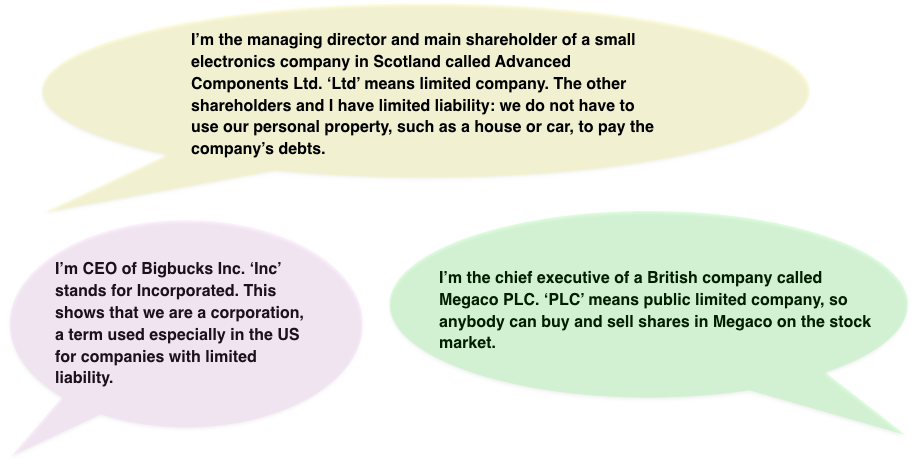
C | Mutuals
Some companies, like certain life insurance companies, are mutual. When you buy insurance with the company you become a member. Profits are theoretically owned by the members, so there are no shareholders.
In Britain, another kind of mutual is building societies, which lend money to people who want to buy a house. But a lot of building societies have demutualized: they have become public limited companies with shareholders. This process is demutualization.
D | Non-profit organizations
Organizations with ‘social’ aims such as helping those who are sick or poor, or encouraging artistic activity, are non-profit organizations (British English) or non-for-profit organizations (American English). They are also called charities, and form the voluntary sector, as they rely heavily on volunteers (unpaid workers). They are usually managed by paid professionals, and they put a lot of effort into fund-raising, getting people to donate money to the organization in the form of donations.
- A | Self-employed people and partnerships
- Look at the words in A and B opposite. What type of organization is each of these?
- 1. A group of engineers who work together to provide consultancy and design
services. There are no outside shareholders.- corporation
- public limited company
- freelancer
- partnership
- limited company
- 2. A large British engineering company with 30,000 employees. Its shares are
bought and sold on the stock market.- limited company
- public limited company
- freelancer
- partnership
- corporation
- 3. An American engineering company with outside shareholders.
- partnership
- freelancer
- limited company
- corporation
- public limited company
- 4. An engineer who works by herself providing consultancy. She works from home
- corporation
- limited company
- freelancer
- public limited company
- and visits clients in their offices.
- partnership
- 5. An independent British engineering company with 20 employees. It was founded
by three engineers, who are shareholders and directors of the company. There are
five other shareholders who do not work for the company.- limited company
- freelancer
- partnership
- corporation
- public limited company
- 1. A group of engineers who work together to provide consultancy and design
- Complete this newspaper article with the correct form of the words from C opposite.
- Angry scenes as members reject .
There were angry scenes at the Suffolk ‘s annual meeting as the society’s rejected by two to one a recommendation from its board that the society be . Members had travelled from all over the country to attend the meeting in London. The Suffolk’s chief executive, Mr. Andrew Davies, said ‘This is a sad day for the Suffolk. We need to to bring the society forward into the 21st century. Our own resources are not enough and we need capital from outside shareholders.’
Gwen Armstrong, who for 32 years said, ‘Keeping status is a great victory. Profits should stay with us, and not go to outside shareholders.’
- Angry scenes as members reject .
- Match the sentences beginnings to the correct endings. The sentences all contain expressions from D opposite.
- 1. British companies donate around £500 million a year to charities . . .
- with loss-making companies!
- in cash and, increasingly, as goods, services and time.
- when they are helping people in their own social class.
- less than than they would in the private sector.
- parties for the charity.
- 2. She organized fund-raising . . .
- less than than they would in the private sector.
- with loss-making companies!
- in cash and, increasingly, as goods, services and time.
- parties for the charity.
- when they are helping people in their own social class.
- 3. Voluntary sector employees earn five to ten per cent . . .
- in cash and, increasingly, as goods, services and time.
- when they are helping people in their own social class.
- with loss-making companies!
- parties for the charity.
- less than than they would in the private sector.
- 4. Non-profit organizations are not to be confused . . .
- with loss-making companies!
- when they are helping people in their own social class.
- in cash and, increasingly, as goods, services and time.
- parties for the charity.
- less than than they would in the private sector.
- 5. Research shows that volunteers give the best service . . .
- parties for the charity.
- when they are helping people in their own social class.
- in cash and, increasingly, as goods, services and time.
- with loss-making companies!
- less than than they would in the private sector.
- 1. British companies donate around £500 million a year to charities . . .
- Over to you
- Is self-employment common in your country? Does the government encourage it?
Name some mutual companies. What sort of reputation do they have?
Are charities important? Which are the most active in your country?
- Is self-employment common in your country? Does the government encourage it?
© 2020 DrillPal.com