


May 19, 2016
- Read through the explanations.
- A | Old and new ways
• I’m an office worker in an insurance company. It’s a nine-to-five job with regular working hours. The work isn’t very interesting, but I like to be able to go home at a reasonable time.
• We all have to clock in and clock out every day. In this company, even the managers have to, which is unusual!
Note: You also say clock on and clock off.
• I’m in computer programming. There’s a system of flexitime in my company, which means we can work when we want, within certain limits. We can start at any time before eleven, and finish as early as three, as long as we do enough hours each month. It’s ideal for me as I have two young children.
• I work in a car plant. I work in shifts. I may be on the day shift one week and the night shift the next week. It’s difficult changing from one shift to another. When I change shifts, I have problems changing to a new routine for sleeping and eating.
• I’m a commercial artist in an advertising agency. I work in a big city, but I prefer living in the country, so I commute to work every day, like thousands of other commuters. Working from home using a computer and the Internet is becoming more and more popular, and the agency is introducing this: it’s called teleworking or telecommuting. But I like going into the office and working with other people around me.
B | Nice work if you can get it
All these words are used in front of ‘job’ and ‘work’:
• satisfying, stimulating, fascinating, exciting: the work is interesting and gives you positive feelings
• dull, boring, uninteresting, unstimulating: the work is not interesting
• repetitive, routine: the work involves doing the same things again and again
• tiring, tough, hard, demanding: the work is difficult and makes you tired.
C | Nature of work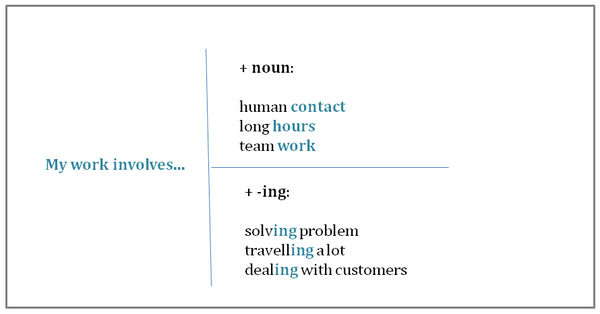
- A | Old and new ways
- Fill the gaps in the sentences below. Use A opposite.
- I’m an in an insurance company. It’s a with regular .
- We all have to and every day.
- I’m in computer programming. There’s a system of in my company, which means we can work when we want, within certain limits.
- I work in a car plant. I work . I may be on the one week and the the next week.
- using a computer and the Internet is becoming more and more popular, and the agency is introducing this: it’s called or .
- I’m an in an insurance company. It’s a with regular .
- Which person is most likely to do each of the five things?
- A software designer in an Internet company. Has to be in the office.
- telecommute
- clock on and off at the same time every day
- commute to work
- work under a flexitime system
- work in shifts
- An office worker in a large, traditional manufacturing company.
- clock on and off at the same time every day
- telecommute
- commute to work
- work in shifts
- work under a flexitime system
- A manager in a department store in a large city. Lives in the country.
- clock on and off at the same time every day
- commute to work
- telecommute
- work under a flexitime system
- work in shifts
- A construction worker on a building site where work goes on 24 hours a day.
- clock on and off at the same time every day
- work in shifts
- telecommute
- work under a flexitime system
- commute to work
- A technical writer for a city computer company. Lives in the country.
- commute to work
- work in shifts
- clock on and off at the same time every day
- telecommute
- work under a flexitime system
- A software designer in an Internet company. Has to be in the office.
- Five people talk about their jobs. Put the words below into the correct grammatical forms.
- Flight attendant:
‘Obviously, my work involves . . . a lot. It can be quite physically . . . , but I enjoy . . . with customers, except when they become violent. Luckily this doesn’t happen often.’- travelling, tiring, dealing
- travel, tire, deal
- Accountant:
‘I like . . . with figures, but my job is much less . . . and routine than people think. The work . . . a lot of human contact and teamwork, working with other managers.’- work, bore, involve
- working, boring, involves
- Postwoman:
‘Of course, it involves getting up quite early in the morning. But I like . . . out in the open air. And I get a lot of exercise!’- being
- to be
- Software developer:
‘You’ve got to think in a very logical way. The work can be mentally . . . , but it’s very satisfying to write a program that works.’- tire
- tiring
- Teacher:
‘I love my job. It’s very . . . and not at all . . . : no two days are the same. It’s good to see the children learn and develop.’- stimulate, repeat
- stimulating, repetitive
- Flight attendant:
© 2020 DrillPal.com